Founder branding isn’t about being loud on LinkedIn or posting just to stay visible. For B2B founders, it’s about clarity in thinking, consistency in presence, and a point of view that people can connect with over time.
This matters because B2B sales cycles are long. Buyers take time to evaluate, compare, and trust. A visible founder adds a human face to that process, making the company easier to understand and remember. That’s why more B2B founders are slowly realizing that showing up with intent works better than staying silent or blending in.
In this blog, we’ll look at B2B founders who are using LinkedIn effectively and break down what you can actually learn from them.
10 Best Examples of B2B Founder Brands on LinkedIn
Below are the B2B founders who have built strong, credible personal brands on LinkedIn:
1. Tyler Denk (beehiiv)
Tyler, the cofounder of beehiiv, has built his LinkedIn presence by sharing the business as it unfolds. He regularly posts product updates, talks about what the team is shipping, and openly shares problems beehiiv is working through, not just the wins. The content feels current and honest, almost like a public build log.
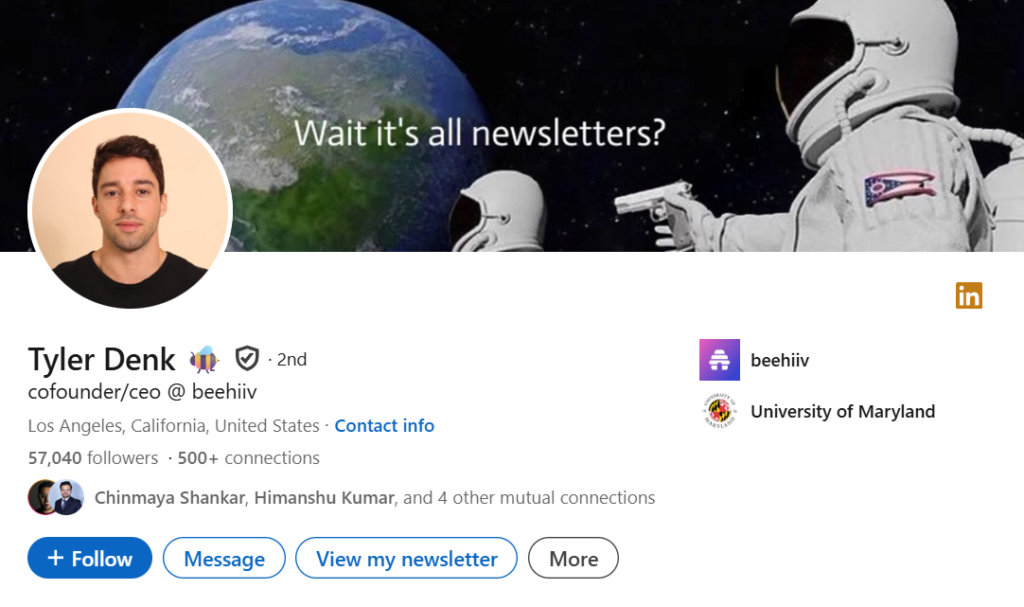
To avoid sounding repetitive, he mixes in humor, sarcastic takes, vacation plans, and invites fellow founders into conversations. He’s also active in the comments, engaging directly when users raise questions or issues. His newsletter, Big Desk Energy, carries the same voice beyond LinkedIn and helps him stay top of mind without forcing promotion.
2. Andrew Gazdecki (Acquire.com)
Andrew, Founder and CEO of Acquire.com, has built his LinkedIn brand around market insight and deal reality. He posts frequently, often daily, sharing what’s happening inside the acquisition market, like live deal data, exit patterns, buyer behavior, and real founder stories. Most posts are educational first, using clear examples and short narratives to explain how exits actually work, especially when markets shift.
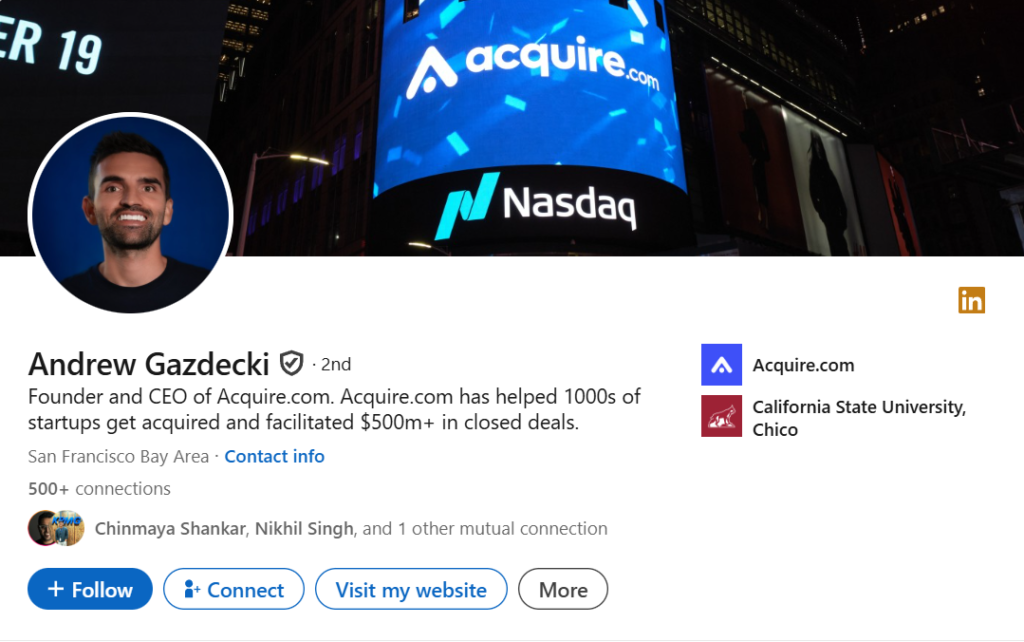
Promotion is present but controlled. Acquire.com is woven into the content as context, not pushed as an ad. He also reposts customer stories, webinars, and team-led insights, reinforcing credibility at scale. His engagement style is thoughtful and measured, focusing on substance over hype, which fits founders navigating serious, high-stakes decisions.
3. Adam Robinson (Retention.com & RB2B)
Adam’s founder brand works because it feels like you’re getting the playbook and the behind-the-scenes at the same time. He posts very frequently and alternates between tactical lessons (metrics, growth stages, churn realities), founder POV posts (bootstrapping, patience, focus), and timely conversations with other operators through live shows and interviews.
That mix keeps his feed from becoming “just marketing,” even though his companies are clearly part of the story. He promotes, but he does it through narrative and proof. Instead of pushing features, he shares numbers, trade-offs, mistakes, and what he’s changing next.
He also leans into humor and storytelling, which makes the brand memorable without trying too hard. Engagement-wise, he invites replies on purpose (“grade me A–F”) and his comment sections turn into real discussions, not polite claps.
4. Vitalii Dodonov (Stan)
Vitalii, Co-Founder at Stan, is a great example of a founder who builds a brand by building community in public. He posts often, but the content isn’t just “we’re growing.” He shares hiring decisions, internal lessons, and how he thinks about talent density, culture, and execution.
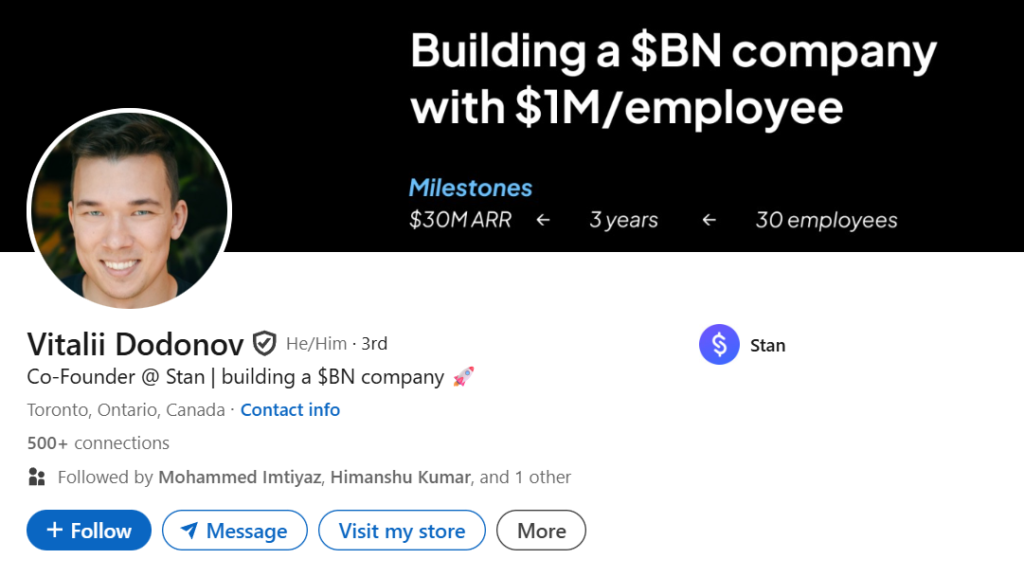
Even when he’s promoting something, it’s wrapped in a story, a principle, or a real number (like candidate quality or costs), so it reads as insight first and marketing second.
Another thing he does well is turning posts into participation. He ends with questions, asks Toronto for ideas, and uses comments as the application funnel for events and hiring. That creates two-way engagement and makes his LinkedIn feel like a living community, not a feed of announcements.
5. Jason Smith (Klue)
Jason, CEO and Co-Founder at Klue, isn’t focused on posting every day. Instead, he shows up when there’s something meaningful to share. His content consistently goes deep into competitive intelligence, win-loss, and how AI actually performs in real GTM scenarios, not in theory.
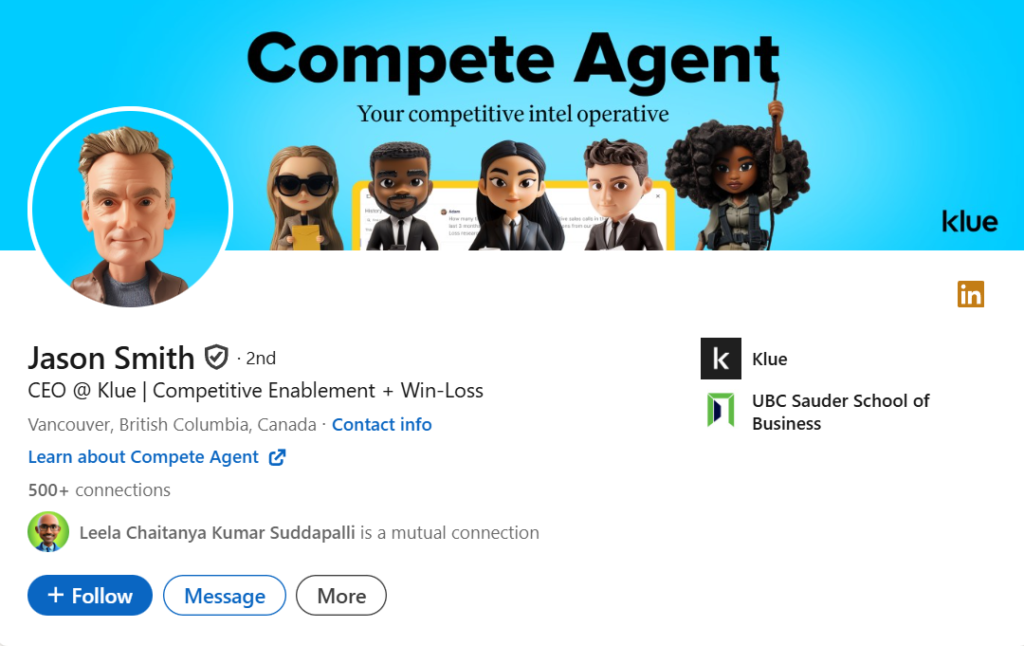
Most of his posts explain the thinking behind Klue’s product decisions, especially around human-in-the-loop AI and trust. Promotion is subtle and tied to customer stories, launches, or market shifts rather than feature hype. The result is a founder brand built on depth and credibility, where consistency of insight matters more than frequency.
6. Sam Jacobs (Pavilion)
Sam, Founder and CEO of Pavilion, builds his LinkedIn brand like a publisher, not just a founder. He posts consistently and uses the platform to share long-form thinking—often through his newsletter, on topics like revenue leadership, careers, market shifts, and how to operate with clarity in noisy times. A lot of his posts read like a smart memo: structured, opinionated, and meant to be saved.
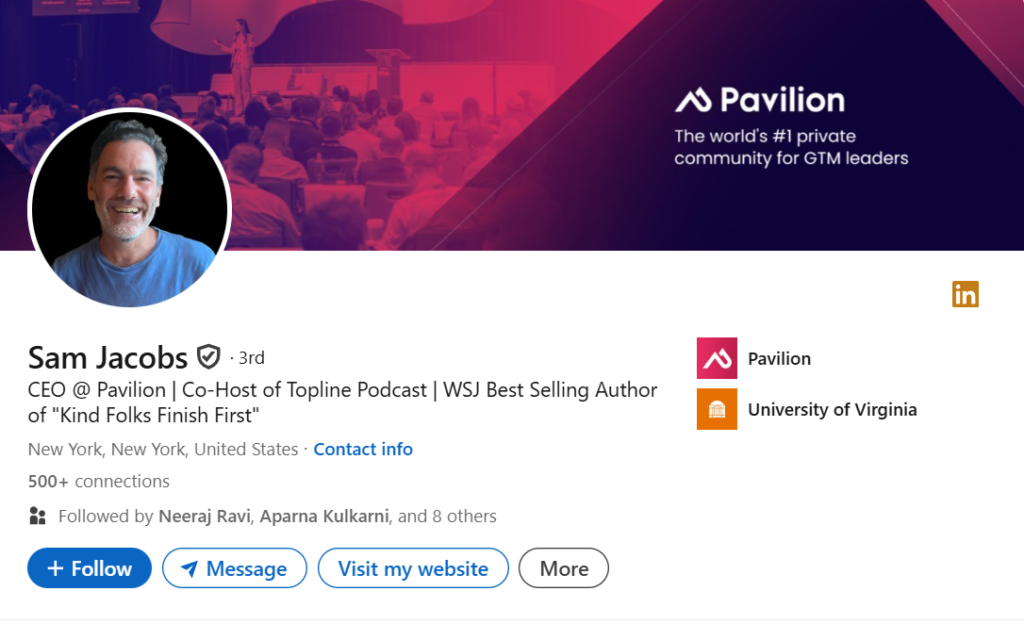
He promotes Pavilion, but usually through value-first content and community stories. Retreat recaps, programs like CRO School, and behind-the-scenes moments show what the network actually does, instead of selling it with generic claims. He also mixes in personal observations and travel notes, which makes the feed feel human while still staying anchored to GTM leadership.
7. Jimmy Kim (eCom Email Marketer)
Jimmy, CEO & Co-Founder at eCom Email Marketer, uses LinkedIn to break down how retention actually works after the purchase. His posts focus on post-purchase emails, habit formation, and customer psychology, often using simple examples, rewritten copy, and real brand scenarios to explain why certain messages convert and others don’t.
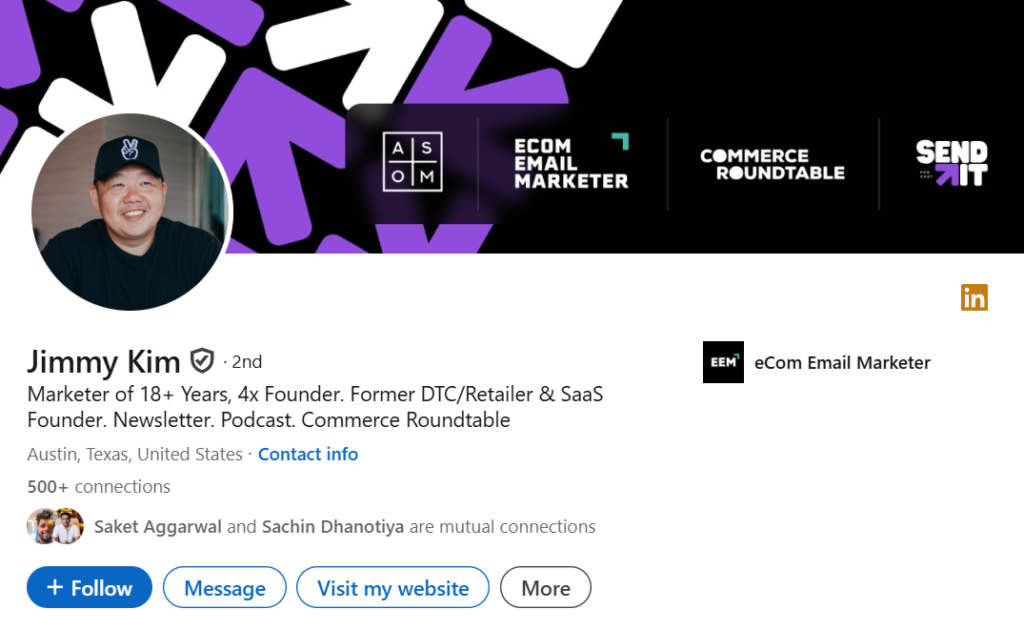
He rarely pushes offers directly. Instead, his company, newsletter, podcast, and events appear naturally through reposts and follow-up content tied to the lesson he’s teaching. The content feels practical and specific, which is why his comment sections tend to fill with marketers reacting, saving, and testing what he shares.
8. Rob Hoffman (Contact.so, Mentions.so, Kleo)
Rob uses LinkedIn to explain why brand mentions matter more than clicks. His content is tightly aligned with Mentions.so, focusing on how visibility is shifting from traditional SEO to being cited in AI answers, LLMs, and zero-click experiences. He often shares posts breaking down data like how ChatGPT, Google AI Overviews, and Reddit influence brand discovery, or why traffic alone no longer tells the full story.
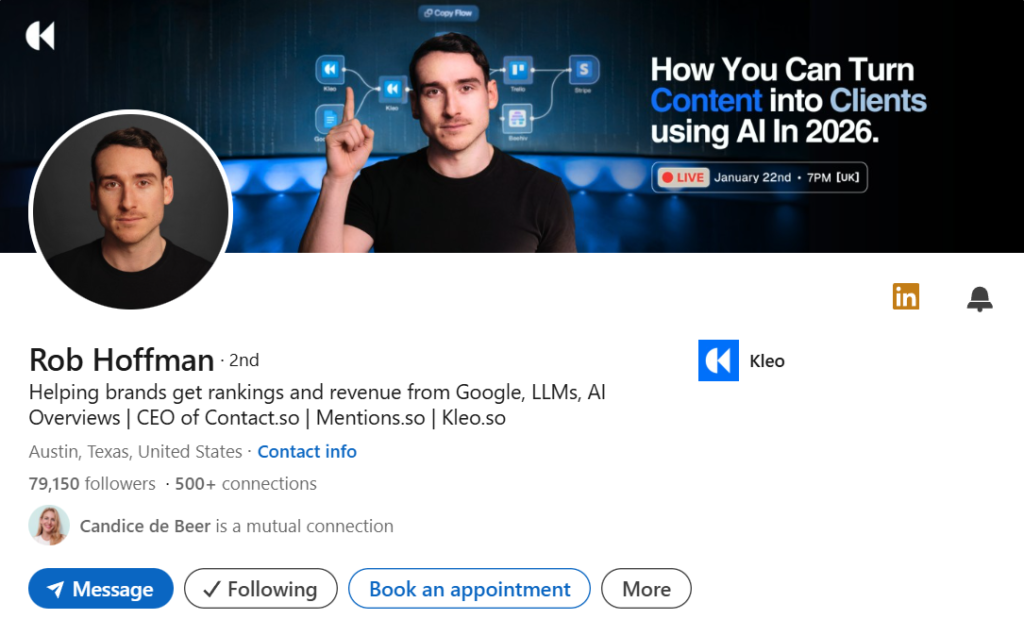
Instead of hard selling, he educates around the problem first, brands being invisible in AI conversations, then positions Mentions.so as the way to track and fix that gap. His posts are data-backed, specific, and built for founders and marketers thinking ahead of search trends.
9. Rytis Lauris (Omnisend)
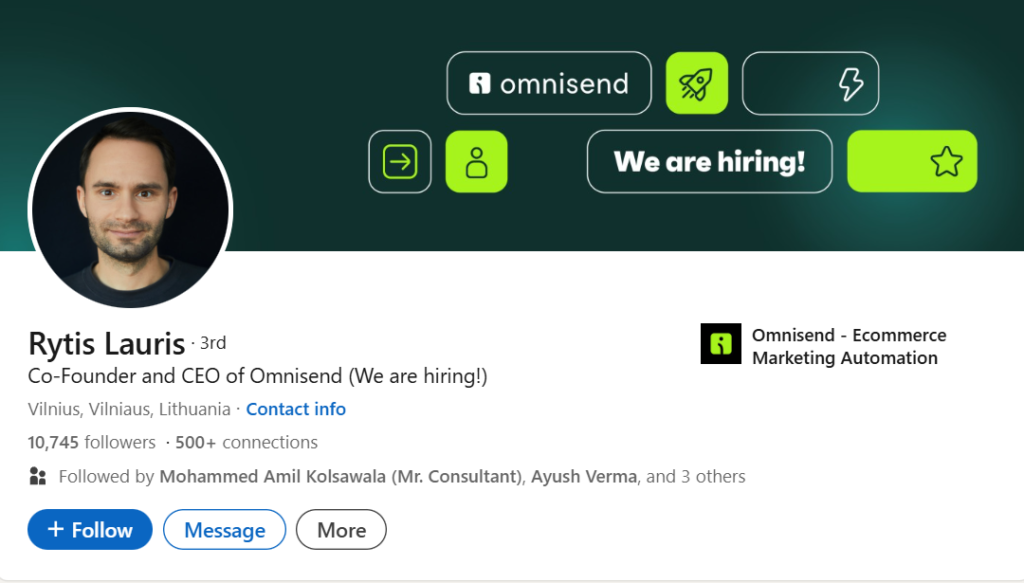
Rytis, Co-Founder and CEO of Omnisend, is a strong example of how founder branding can feel local even at a global company. He regularly posts in Lithuanian when addressing topics that matter to his home audience, while switching to English for product updates, ecommerce data, and global marketing insights.
This isn’t accidental. By localizing language, he speaks directly to different audiences without watering down his message. His Lithuanian posts often drive high engagement because they feel personal and rooted, not translated for reach. It shows that founder branding doesn’t have to be one-size-fits-all to work globally.
10. Vanhishikha Bhargava (Contensify)
Vanhishikha Bhargava uses LinkedIn as a classroom, not a highlight reel. Her content consistently breaks down how content, SEO, and demand actually work in the AI and LLM era. She teaches by explaining why things fail, not just what to do, which makes her posts practical and hard to ignore.
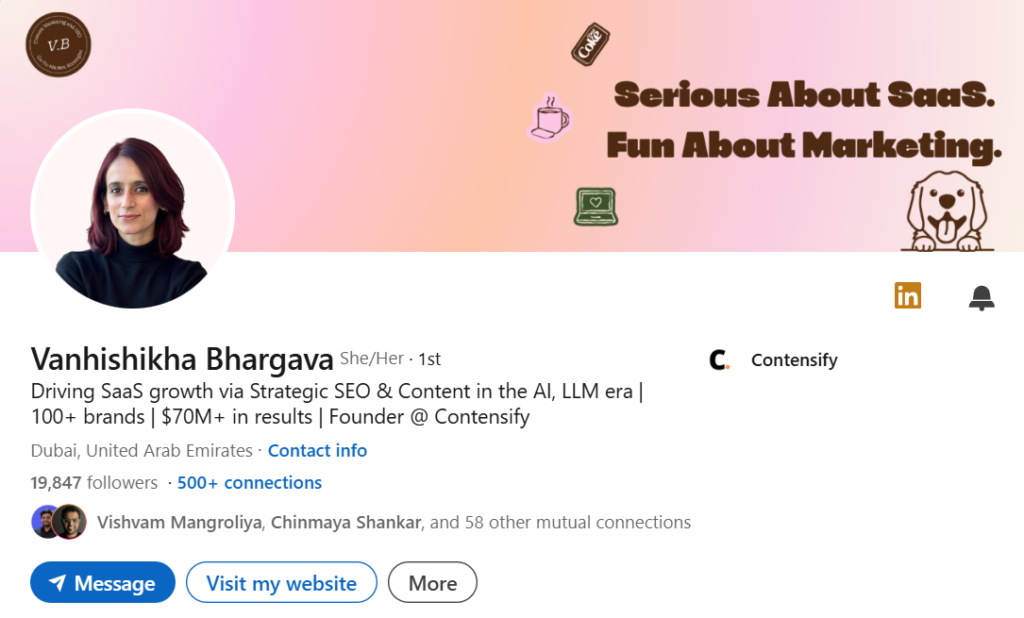
She also builds in public, openly sharing how she’s growing her personal brand, her products, and Contensify. Her newsletter extends these lessons beyond LinkedIn, and she uses video content to add depth and keep engagement high. Unlike founders who post and disappear, Vanhishikha actively responds to comments and questions, turning each post into a two-way learning loop. You can connect with her here.
Conclusion
Founder branding isn’t a personality trait. It’s a system. One built on clear thinking, repeatable structure, and intentional visibility over time.
Most founders already have the raw material, like experience, opinions, lessons, and stories from building every day. What’s usually missing isn’t effort, but structure and intent in how those ideas show up publicly.
That’s exactly where The Brand Strategy Labs comes in. If you want to turn what you already know into a founder brand that compounds trust and demand, work with us. We’ll help you build it the right way.